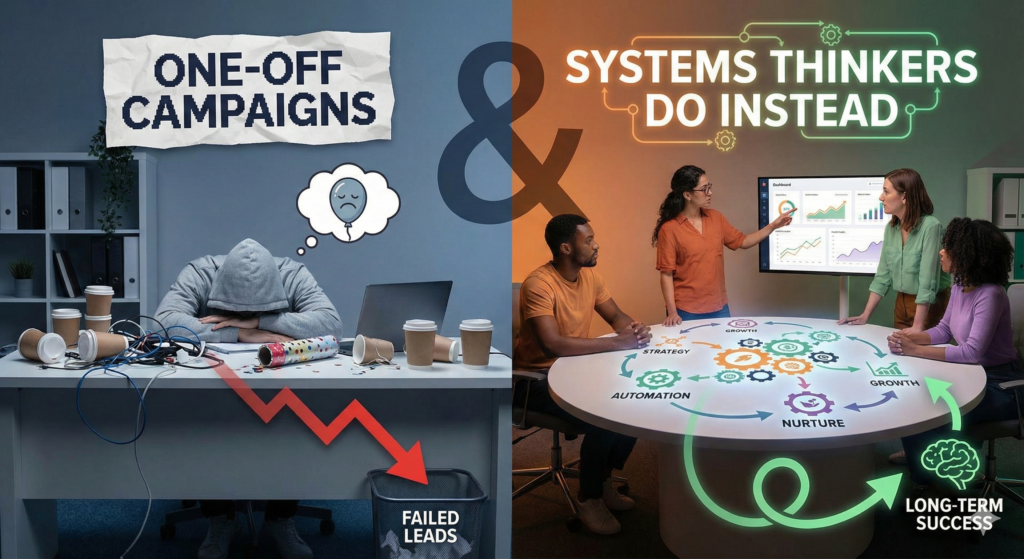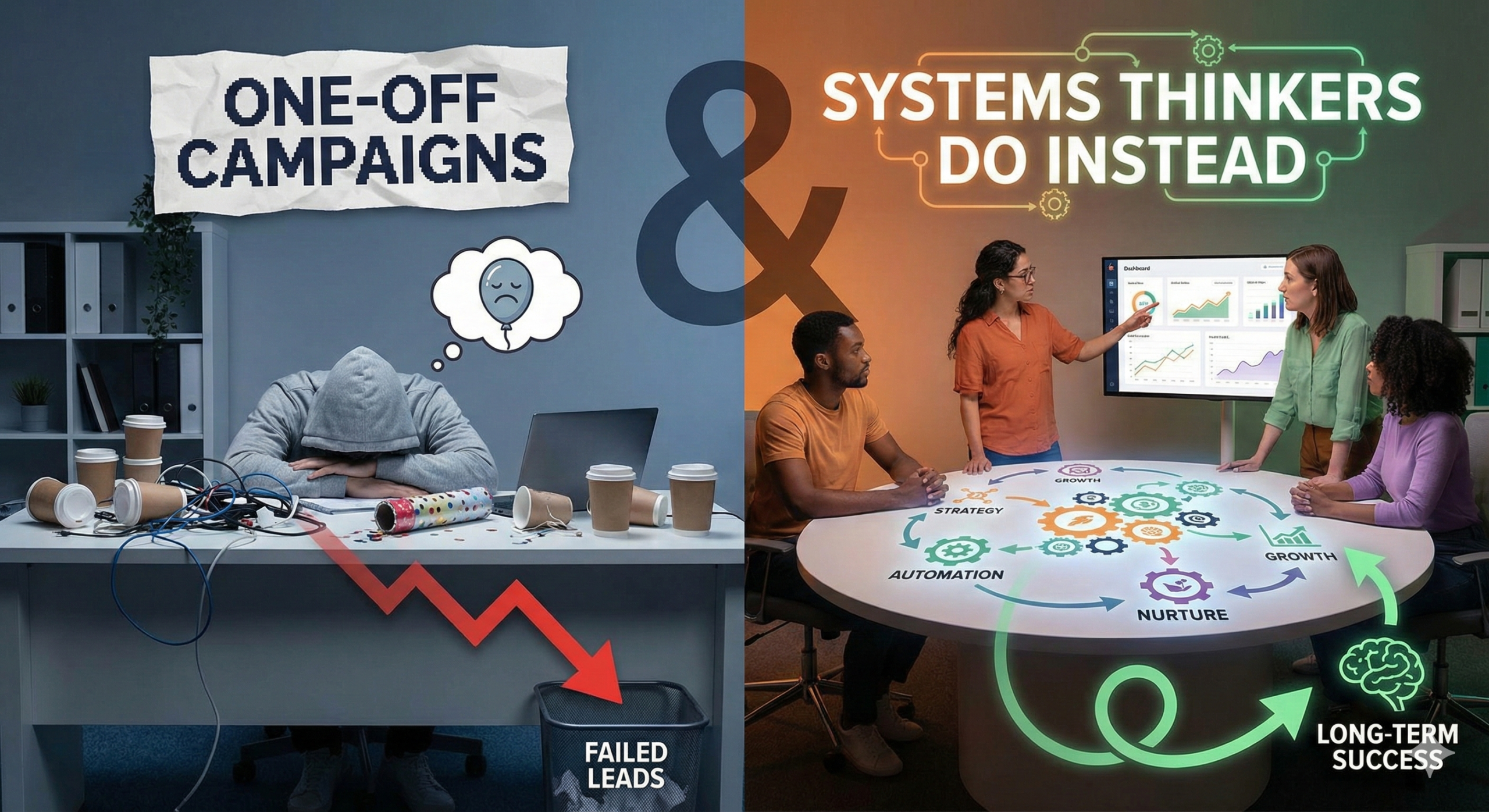
You launched a campaign last month. Dumped the budget into it. Watched the metrics climb. Felt good about the spike in traffic, maybe even a few conversions. Then you turned it off.
Now what?
You’re back at square one. Staring at a blank calendar, wondering which creative angle to bet on next. Debating whether to go heavy on Instagram this time or throw money at Google. Starting from zero—again.
Welcome to the hamster wheel of one-off campaign thinking. It’s exhausting, unpredictable, and quietly bleeding your growth potential. Worse, it trains your team to think in bursts instead of building momentum. Every quarter becomes a scramble to “figure out what works,” as if your market resets itself every ninety days.
Spoiler: it doesn’t.
The businesses pulling ahead right now? They stopped thinking in campaigns. They started thinking in systems. And the gap between the two approaches isn’t just philosophical—it’s measurable, repeatable, and ruthlessly effective.
Let’s pull apart why one-off campaigns betray you, what systems thinkers do differently, and how you can make the shift before your competitors do.
The Seductive Lie of the Campaign Mindset
Campaigns feel productive. They have beginnings, middles, and ends. You set a goal, allocate resources, execute, measure, and then move on. It mirrors how we’re taught to think about projects in school and early career roles: finite, contained, controllable.
But buyer behavior isn’t a project. It’s a flowing river, not a static pond.
When you run isolated campaigns, you’re essentially showing up to a cocktail party, shouting your pitch at strangers, then leaving before anyone responds. Some might remember you. Most won’t. A rare few will act immediately. The rest? Gone.
Here’s what actually happens inside a one-off campaign cycle:
Week 1-2: You’re training the algorithm. Your ads are expensive because platforms don’t yet understand who converts. Your creative is untested. Your landing page has no prior visitor data to optimize against.
Week 3-4: Things start clicking. The algorithm finds your people. Your cost-per-acquisition drops. You’re seeing momentum.
Week 5: Budget runs out, or the “campaign end date” arrives. You flip the switch to off.
Week 6: Silence. All that learning—the audience insights, the creative performance data, the behavioral signals—sits idle. Your brand disappears from the feeds and search results of people who were just starting to remember you.
Then next quarter, you start over with a new angle, new creative, and the algorithm begins its learning curve again. You’ve torched weeks of compounding momentum for the illusion of a “fresh start.”
The Attention Economy Doesn’t Respect Your Campaign Calendar
Human memory and trust-building operate on entirely different timelines than your marketing calendar. Cognitive psychology research consistently shows that familiarity breeds preference. Buyers need 7-13+ meaningful touches before they trust a brand enough to act—sometimes more for high-consideration purchases like remodeling, luxury goods, or community home sales.
One-off campaigns typically deliver 2-4 touches max before they vanish.
Consider the home remodeler who runs a May promotion for kitchen renovations. She targets homeowners in a ten-mile radius, uses before-and-after creative, and offers a spring discount. Gets some leads. Converts a couple. Then pulls the campaign in June to “save budget.”
What she doesn’t see: the 200+ people who clicked, browsed, maybe even saved the site or told a partner, “We should think about this.” Those people weren’t ready that week. But they might have been ready in August. Or October, when the bonus check hits. Or next February, when the old countertop finally cracks.
By pulling the campaign, she became a ghost. She surrendered all the mental real estate she’d started to occupy. When those buyers finally decide to move forward, they’ll search again—and find the competitor who never left. One-off thinking assumes buying happens on your timeline. Systems thinking recognizes that buying happens on its own.
The Compounding Cost of Restarting
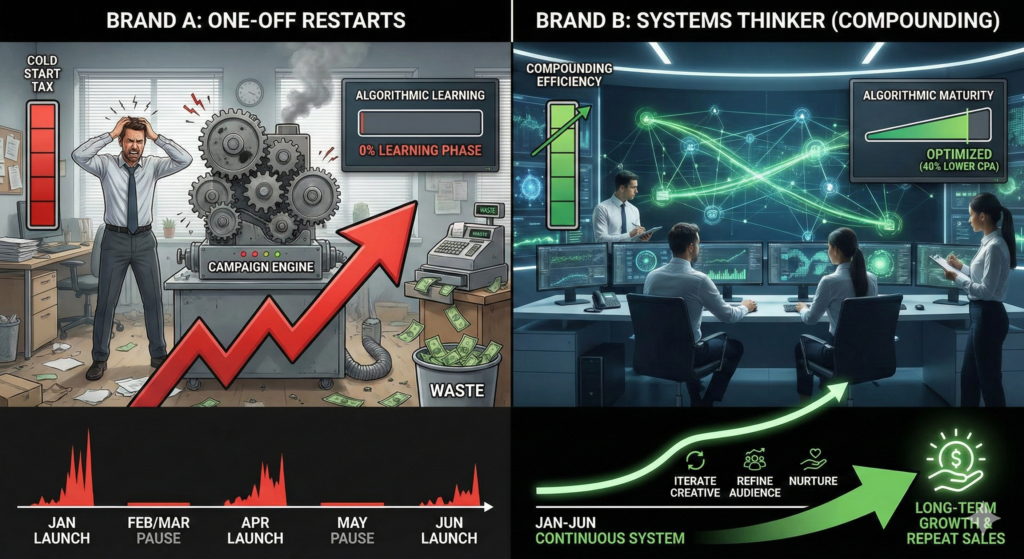
Let’s talk money. One-off campaigns cost more per result than systems—sometimes double or triple—because you’re constantly paying the “cold start tax.”
Every time you launch a new campaign with new creative, new targeting, or new messaging, you reset the machine learning that powers modern advertising platforms. Facebook, Google, TikTok, LinkedIn—they all rely on feedback loops. Show ad → user responds (or doesn’t) → algorithm adjusts → show refined ad → measure again.
The longer you run consistent, strategic activity, the smarter the platform becomes at finding your exact buyer and serving them the right message at the right moment. Stop-start campaigns never reach algorithmic maturity. You’re perpetually stuck in the expensive “learning phase.”
Imagine two CPG brands launching the same month:
Brand A (Campaign Thinker): Runs a six-week push in January. Pauses February and March. Runs another push in April around a new SKU. Pauses May. Runs a summer burst in June.
Brand B (Systems Thinker): Runs continuous, scaled activity from January onward. Adjusts budget up or down based on performance and inventory. Rotates creative every 3-4 weeks. Refines audiences as data accumulates.
By June, Brand A has relaunched three times. Each launch costs them time, money, and learning. Brand B has been iterating on the same funnel for six months. Their cost per acquisition is 40% lower. Their repeat purchase rate is higher because they’ve nurtured buyers post-sale. Their brand recall in surveys is 3x stronger.
Same budget, radically different outcomes.
What Systems Thinkers Actually Build
A system isn’t a campaign that runs forever. It’s an interconnected engine designed to attract, convert, and retain buyers regardless of calendar date. It has these core elements:
1. Always-On Audience Development
Systems thinkers run persistent prospecting. Not at max spend every day, but enough to continuously feed the top of the funnel. This creates a renewable pool of warm traffic—people who’ve seen your brand, engaged with content, visited your site—that you can convert over time.
Picture a luxury watch brand. Instead of running occasional “new collection” blitzes, they maintain ongoing content: watchmaking videos, collector interviews, heritage stories. These run at modest cost across YouTube, Instagram, and Facebook. The goal isn’t immediate sales—it’s building an audience layer of watch enthusiasts who’ve signaled interest.
Once someone watches 50% of a video or visits the journal section of the site, they enter segmented retargeting pools. Months later, when a limited edition drops, the brand has thousands of warm contacts ready to receive the announcement. Conversion rates are 5-10x higher than cold launches because trust and desire were pre-built.
2. Integrated Conversion Funnels That Never Sleep
A system treats every stage of the buyer journey—not just the moment of purchase. That means running:
- Top-of-funnel content and social proof to spark interest
- Mid-funnel educational content, comparison tools, and testimonials to reduce uncertainty
- Bottom-funnel retargeting, offer-based ads, and urgency plays for people ready to act
- Post-purchase onboarding, satisfaction loops, and referral prompts to increase lifetime value
For a home builder selling new communities, this looks like:
- Top: Targeted ads and blog content about “best school districts” or “walkable neighborhoods” in their metro area
- Mid: Virtual tours, comparison guides, and buyer testimonials served to site visitors
- Bottom: Model home appointment offers and financing explainers for people who’ve viewed floor plans
- Post: Welcome series for buyers, community event invites, referral incentives
Everything connects. Every stage feeds into the next. Nobody falls through the cracks because there are no cracks—just pathways.
3. Data That Stacks, Not Resets
Campaign thinkers lose their data every cycle. Systems thinkers build libraries.
Every ad, landing page, email, and piece of creative generates performance data: what resonates, what converts, which segments respond. In a system, that intelligence compounds. You’re not guessing what might work next month—you’re refining what worked last month and scaling it.
A general contractor running an always-on system tracks which pain points in ad copy drive leads (e.g., “fix storm damage fast” vs. “luxury bathroom upgrades”). Over six months, they’ve tested two dozen headline variations, four offer structures, and five audience cuts. They know with precision which combinations produce $50 leads and which burn budget.
When they need to ramp up in spring, they don’t brainstorm from scratch. They deploy proven, profitable combinations at higher spend. Their competitors? Still A/B testing taglines.
4. Feedback Loops From the Front Lines
Systems don’t live in the marketing department alone. They pull insights from sales calls, customer support tickets, installer feedback, and review sentiment.
What objections keep coming up on估 calls? That’s new ad copy. Which product features get the most questions? That’s FAQ content and email material. What delights customers post-sale? That becomes testimonial creative and referral hooks.
A sports marketing agency working with a local team might notice that families ask about parking and kid-friendly seating most often. That intel moves upstream into ads (“Easy parking + family zones”) and downstream into onboarding emails for ticket buyers (“Here’s your parking pass and kids’ activity guide”). The system gets smarter with every interaction.
5. Creative Rotation, Not Creative Chaos
Systems thinkers refresh creative regularly—but strategically. Instead of scrapping everything and starting over, they rotate winning elements, test new angles within proven frameworks, and retire only what demonstrably stops working.
Think of it like a playlist. You don’t delete your entire library every month. You add new tracks, move favorites into rotation, and let stale songs fade. Your audience gets variety without whiplash. The algorithm maintains continuity.
A luxury event brand might run:
- Core evergreen creative (brand story, venue visuals, past event highlights)
- Seasonal angles (holiday galas, summer rooftop series, corporate retreat packages)
- Test creative (new formats, messaging experiments, influencer collabs)
They phase these in and out based on performance, not arbitrary calendar dates. The brand presence never blinks off.
Unique Approach to Restaurant Marketing
What sets Black X Marketing apart is their focus on authentic, emotion-driven marketing rather than overly curated content. The agency recognizes that modern diners seek genuine experiences and connections with the restaurants they choose. Their approach includes:
Human Emotional Marketing Strategy
Black X Marketing moves beyond automated posts and generic content, instead focusing on creating marketing that is “impactful, meaningful, and irresistible”. This approach recognizes that successful restaurant marketing must connect with customers on an emotional level.
Local Market Expertise
With deep roots in San Diego’s restaurant scene, Black X Marketing understands the unique dynamics of different neighborhoods, from the bustling Convoy District to the trendy Little Italy area. This local knowledge enables them to create targeted campaigns that resonate with specific community demographics.
Results-Driven Philosophy
The agency operates on a performance-based model, stating, “If we don’t perform the services we promise, you DON’T PAY”. This commitment to results reflects their confidence in delivering measurable outcomes for restaurant clients.
The Psychological Edge of Persistent Presence
Here’s what most marketers miss: Systems don’t just perform better tactically—they rewire how buyers perceive you.
When someone encounters your brand once, you’re a stranger. Twice, you’re vaguely familiar. Five times, you’re a known entity. Ten times, you’re a category fixture. Persistent, coherent presence across channels triggers the “mere exposure effect”—the psychological principle that repeated exposure increases liking and trust, even without conscious awareness.
Campaign thinkers never reach that threshold. They show up, then vanish, then reappear with different messaging months later. Buyers experience cognitive dissonance. “Wait, is this the same company? What do they even stand for?”
Systems thinkers become mental shortcuts. When the need arises, your brand is the obvious answer—not because you screamed the loudest that week, but because you were reliably, helpfully present when it mattered.
This is how boutique home remodelers beat national chains. How small CPG brands unseat legacy products. How emerging watch brands steal share from heritage names. Not through bigger one-off budgets, but through a persistent, strategic presence that feels unavoidable.
How to Transition from Campaigns to Systems
SShifting mindset is step one. Rebuilding infrastructure is step two. Here’s the roadmap:
Month 1: Audit and Map
Stop launching new campaigns. Instead, map your current buyer journey. Where do people first hear about you? What do they do next? Where do they drop off? What happens post-purchase?
Identify gaps. Most brands discover they have top-of-funnel activity and bottom-funnel conversion tactics—but nothing in between. That’s where buyers leak.
Month 2-3: Build the Middle
Create the connective tissue: retargeting sequences, educational email flows, nurture content that moves people from “aware” to “considering.” You need at least three touch types in this layer:
- Social proof (testimonials, case outcomes, reviews)
- Education (how-tos, comparisons, ROI breakdowns)
- Engagement (quizzes, tools, community content)
Month 4: Install Always-On Prospecting
Launch modest, continuous audience-building activity. Don’t aim for immediate conversions—aim for engagement and signal capture. Run video views campaigns, content engagement ads, or traffic to high-value blog posts.
Feed these audiences into your middle-funnel retargeting.
Month 5-6: Layer in Post-Purchase
Most brands go silent after the sale. Systems thinkers know that’s where lifetime value begins. Build post-sale emails, satisfaction surveys, referral offers, and community-building content.
Turn customers into advocates, and let them feed the top of your funnel.
Ongoing: Iterate, Don’t Invent
Now you have a system. Your job shifts from “what should we do next?” to “what data tells us to improve?” Rotate creative. Test new audiences. Refine messaging. Scale what works. Prune what doesn’t.
You’re no longer gambling on campaigns. You’re optimizing a machine.
Why Most Agencies Keep You Stuck in Campaign Mode
Let’s acknowledge the uncomfortable truth: many agencies benefit from keeping you in campaign cycles.
Campaign work is easier to scope, bill, and showcase. “We ran a Q2 campaign and hit X results” makes a tidy case study. Systems work is messier—it’s ongoing optimization, incremental gains, and long-term partnership. It requires deeper integration with your business, more transparency, and accountability that stretches across quarters, not weeks.
Some agencies lack the infrastructure to manage systems. Others prefer the flexibility of short-term engagements. A few simply don’t understand the difference.
At Black X Marketing, we made a deliberate choice to build around systems because we got tired of watching great brands spin their wheels on campaign treadmills. Omnichannel systems powered by buyer psychology don’t just drive better results—they compound over time. Our clients don’t start from zero every quarter. They start from last quarter’s ceiling.
Real-World Contrast: The Tale of Two Builders
Let’s close with a story that crystallizes the difference.
Two residential builders, both mid-sized, both operating in competitive Sunbelt markets, both launching new communities in the same year.
Builder X hired a traditional agency. The agency proposed quarterly campaigns:
- Q1: “Spring into Your Dream Home” push
- Q2: “Summer Savings Event”
- Q3: “Back to School, Forward to Home”
- Q4: “End-of-Year Close-Out Deals”
Each campaign had new creative, new landing pages, and new messaging. Budget spiked during campaign windows and dropped between them. Leads came in waves, then dried up. Sales cycles were long because most leads were cold. The sales team complained about lead quality. Marketing blamed sales for not closing fast enough.
Builder Y partnered with a systems-focused team. They built:
- Continuous geo-targeted content highlighting lifestyle, schools, and community amenities
- A segmented nurture system based on interests (first-time buyers, downsizers, relocators)
- Automated email sequences for site visitors, tour attendees, and past prospects
- Retargeting that served relevant next-step content (financing info, design options, testimonials)
- Post-close referral incentives and community event marketing
No big “campaign launches.” No gaps. Just a steady, intelligent presence.
Within twelve months, Builder Y’s cost per qualified lead dropped 38%. Their sales cycle shortened by 22 days on average because buyers arrived more educated and more emotionally committed. Their close rate improved 19% because the marketing system pre-qualified and nurtured prospects before they ever spoke to sales.
Builder X sold 42 homes that year. Builder Y sold 71—same market, similar inventory, nearly identical pricing.
The difference? One ran campaigns. The other ran a system.
Your Move
VYou can keep doing what you’ve been doing. Launch campaigns when inspiration strikes or budgets allow. Celebrate spikes, endure valleys, and wonder why growth feels so inconsistent.
Or you can step off the treadmill and build a machine that works while you sleep—one that learns, adapts, and compounds momentum quarter after quarter.
Systems thinking isn’t flashier than campaign thinking. It’s just vastly more effective.
And in a market where attention is fragmented, trust takes time, and buyers move on their own schedules—not yours—effectiveness is the only metric that matters.
Ready to trade the campaign hamster wheel for a system that actually compounds? Black X Marketing specializes in omnichannel advertising systems built on buyer psychology, not guesswork. We work with home builders, remodelers, CPG brands, luxury goods companies, and other ambitious B2C businesses tired of starting from scratch every quarter. Let’s map your system.
Schedule a strategy session at blackxmarketing.com